Fracture at Prior Shoe with Gas Gradient Above
In this section we describe the load case "Fracture at Prior Shoe with Gas Gradient Above" available in Oliasoft WellDesign™.
The Fracture at Prior Shoe with Gas Gradient Above is a collapse load case, where the unknown is the external pressure profile of the tubing.
NOTE!
Note: In this documentation we denote any tubular as tubing. All calculations however encompass any tubular, such as tubings, casings, liners, tie-backs etc.
Summary
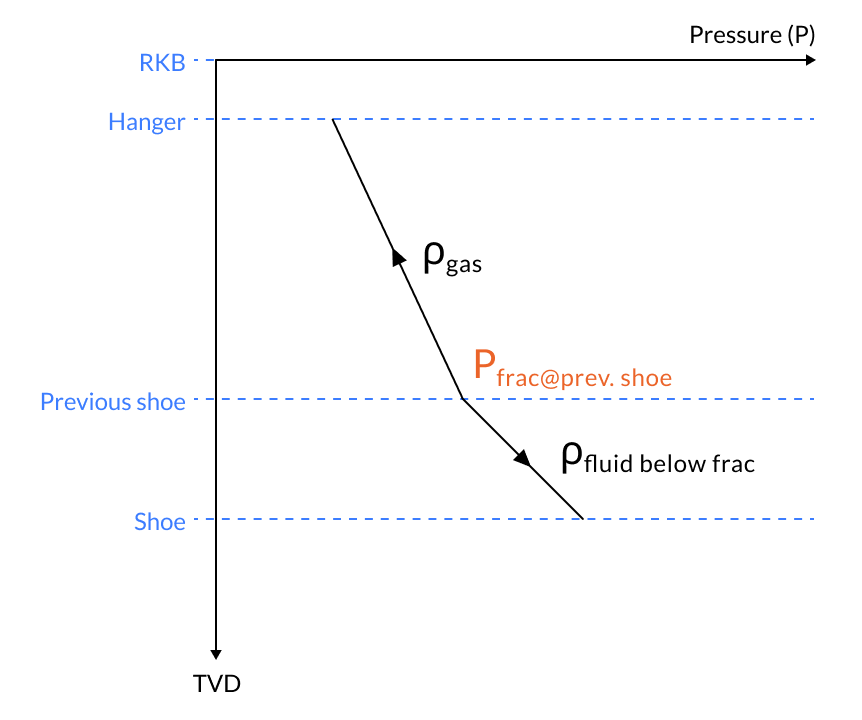
The Fracture at Prior Shoe with Gas Gradient Above is an external collapse load case. The profile is based on the fracture pressure at previous shoe, with a mud gradient from previous casing shoe to the casing shoe, and gas gradient from previous casing shoe to the wellhead.
Illustrating Pressure Profile Graph
Printable Version
Oliasoft Technical Documentation - Fracture at Prior Shoe with Gas Gradient Above
Inputs
The following inputs define the Fracture at Prior Shoe with Gas Gradient Above load case:
- The true vertical depth (TVD) along the wellbore as a function of measured depth. Alternatively, the wellbore described by a set of survey stations, with complete information about measured depth and inclination.
- The true vertical depth / TVD of
- The hanger of the tubing, TVD.
- The shoe of the tubing, TVD.
- The shoe of the prior tubing, TVD.
- The temperature profile of the wellbore, .
- The fracture pressure at prior shoe, P.
- The gas gradient, , or gas specific gravity, .
- The mud weight/density, .
- The gravitational constant, .
- Fracture margin of error, .
Calculation
The external pressure profile is given by the hydrostatic gas profile from the prior shoe to the hanger, and hydrostatic mud profile from prior shoe to the shoe, with fracture pressure at the prior shoe as fix point. If gas specific gravity is entered, , a gas gradient, , is calculated using z-factor and Sutton correlations [1], using the temperature and fracture pressure at the prior shoe as input. Precisely,
References
[1] Curtis H. Whitson and Michael R. Brul. Phase behavior, volume 20 of Henry L. Doherty series. SPE Monograph series, 2000.