Gas Kick
In this section we describe the load case "Gas kick" available in Oliasoft WellDesign™.
Gas Kick is a burst load case, where the unknown is the internal pressure profile of the casing / tubing.
NOTE!
In this documentation we denote any tubular as casing or tubing. All calculations however encompass any tubular, such as tubings, casings, liners, tie-backs etc.
Summary
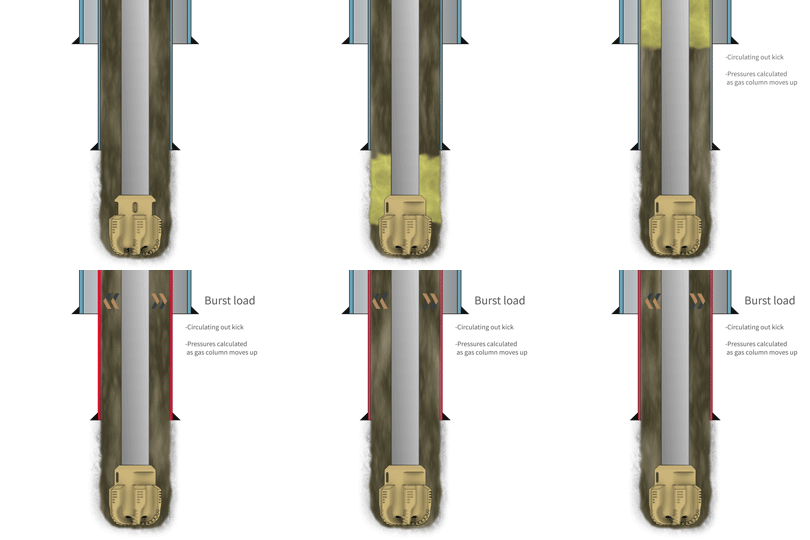
The pressure at the point of influx is determined by the static mud column pressure plus the Kick Intensity. The height of the gas column is then derived from the Kick Volume, well geometry, and annular capacities between the BHA and the wellbore. As the gas rises through the casing, the casing pressure is calculated by subtracting the hydrostatic pressures of both the mud and the gas at the front of the gas.
The Pore Pressure estimate does not influence these calculations; it is only used to indicate the maximum pore pressure within the open hole section. This value can be selected from the Influx Depth dropdown menu.
When the Limit Frac@Shoe option is enabled, the pressure at shoe will be contrained to the fracture pressure if the initial pressure at shoe is higher than the fracture pressure.
Printable Version
Oliasoft Technical Documentation - Gas Kick
Inputs
- The true vertical depth (TVD) along the wellbore as a function of measured depth. Alternatively, the wellbore described by a set of survey stations, with complete information about measured depth and inclination.
- The true vertical depth/TVD of
- The hanger of the tubing, TVD
- The shoe of the tubing, TVD
- The influx depth of the gas, TVD
- The fracture pressure profile from hanger to influx depth
- The kick volume and kick intensity, and , respectively
- The temperature profile of the wellbore,
- The mud weight/density,
- The gas gravity, sg
- Tubing and open hole dimensions
- Whether or not to limit the pressure at shoe by the fracture pressure there. If this is enabled, it is also possible to give a fracture margin or error, which is added to the fracutre pressure.
Scenario Illustration
Calculation
The internal pressure profile of the casing / tubing is calculated by following the front of the gas column, from shoe to hanger. The algorithm goes as follows
-
Calculate the pressure at the influx depth
where is the gravitational constant. This pressure is assumed constant throughout the kick.
-
Calculate the height of the gas column as it rises upwards, using the tubing and open hole dimensions, and the corresponding gas density from Sutton correlations.
-
Calculate the internal pressure, , from influx depth to hanger, as the hydrostatic pressure from mud and gas.
-
If 'Limit to frac at shoe' is enabled, calculate the fracture pressure at the shoe of the tubing, . If in addition, , calculate the hydrostatic pressure from shoe to hanger as if the casing / tubing is filled with mud, .
-
The internal pressure of the tubing is then
reported from shoe to hanger.
References
[1] Curtis H. Whitson and Michael R. Brule ́. Phase behavior, volume 20 of Henry L. Doherty series. SPE Monograph series, 2000.
[2] Sutton, R.P.: “Compressibility Factors for High-Molecular Weight Reservoir Gases,” paper SPE 14265 presented at the 1985 SPE Annual, Technical Conference and Exhibition, Las Vegas, Nevada, 22–25 September.