In this section we describe the load case "Tubing leak" available in Oliasoft WellDesign™.
Tubing leak is a burst load case, where the unknown is the internal pressure profile of the casing / tubing.
NOTE!
In this documentation we denote any tubular as casing or tubing. All calculations however encompass any tubular, such as tubings, casings, liners, tie-backs etc.
Summary
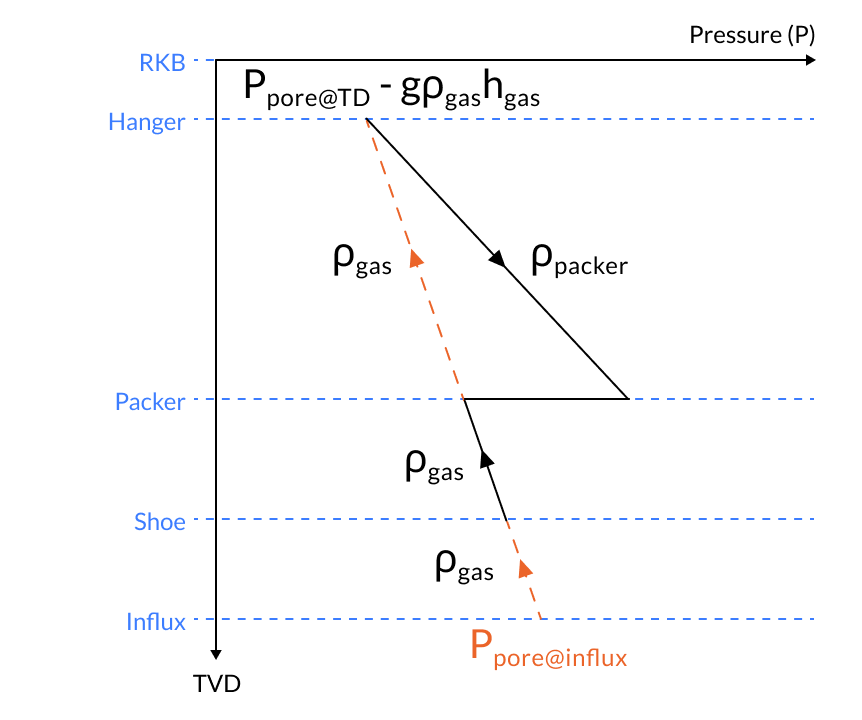
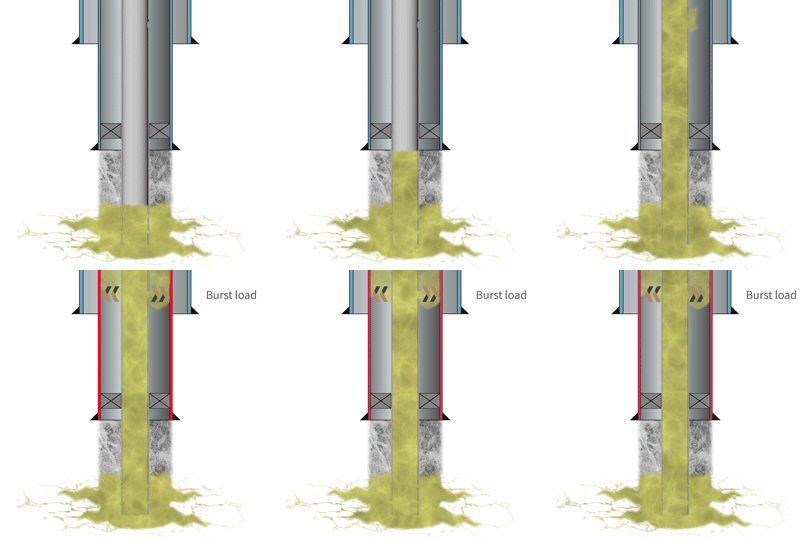
Tubing leak is a burst load for the production casing. It is assumed a leak close to the hanger from the tubing and the tubing annulus. The pressure at the hanger is determined by subtracting the gas column from the pore pressure at the perforation depth. This load case follows a conservative approach, assuming that the tubing annulus is filled with packer fluid. Consequently, the pressure profile from the hanger to the packer is defined by the hanger pressure with packer fluid beneath it. Moving from the packer to the casing shoe, the pressure is determined by subtracting the gas gradient from the pore pressure at the influx depth.
Illustrating Pressure Profile Graph
Printable Version
Oliasoft Technical Documentation - Tubing Leak
The following inputs define the tubing leak load case
- The true vertical depth (TVD) along the wellbore as a function of measured depth. Alternatively, the wellbore described by a set of survey stations, with complete information about measured depth and inclination.
- The true vertical depth / TVD of
- The hanger of the tubing, TVDhanger
- The shoe of the tubing, TVDshoe
- The packer depth, TVDpacker
- The perforation depth, TVDperforation
- The pore pressure profile from hanger to influx depth.
- The packer fluid density, ρpacker
- The temperature at the perforation depth, Tperforation
- The gas gravity, sggas
Scenario Illustration
Calculation
The internal pressure profile of the casing / tubing is calculated as follows
-
Calculate the pore pressure at perforation depth, pp,perforation
-
Calculate the gas density at perforation depth from gas gravity, using Sutton correlations, ρgas,perforation
-
Calculate the pressure at the hanger
phanger=pp, perforation−ρgas, perforationg(TVDperforation−TVDhanger) (1)
where g is the gravitational constant.
-
The internal pressure of the tubing depends on where the packer- and perforation- depth are related to each other and the shoe of the tubing. Explicitly, parametrize the tubing by TVD
-
If TVDshoe≤TVDpacker≤TVDperforation, or if TVDshoe≤TVDperforation≤TVDpacker, then
pi=phanger+ρpackerg(TVD−TVDhanger) (2)
-
If TVDpacker≤TVDshoe≤TVDperforation, then from hanger to packer
pi=phanger+ρpackerg(TVD−TVDhanger), (3)
and from packer to shoe
pi=pperforation−ρgas, perforationg(TVDperforation−TVD). (4)
-
If TVDpacker≤TVDperforation≤TVDshoe, then from hanger to packer
pi=phanger+ρpackerg(TVD−TVDhanger) (5)
from packer to perforation
pi=pperforation−ρgas, perforationg(TVDperforation−TVD) (6)
and finally from perforation to shoe
pi=pperforation+ρpackerg(TVD−TVDperforation) (7)
-
If 4.1 = 4.2, then from hanger to perforation
pi=phanger+ρpackerg(TVD−TVDhanger)(8)
and from perforation to shoe
pi=pperforation+ρpackerg(TVD−TVDperforation). (9)
-
The last scenario, TVDperforation≤TVDpacker≤TVDshoe, is physically impossible
References
[1] Curtis H. Whitson and Michael R. Brule ́. Phase behavior, volume 20 of Henry L. Doherty series. SPE Monograph series, 2000.
[2] Sutton, R.P.: “Compressibility Factors for High-Molecular Weight Reservoir Gases,” paper SPE 14265 presented at the 1985 SPE Annual, Technical Conference and Exhibition, Las Vegas, Nevada, 22–25 September.